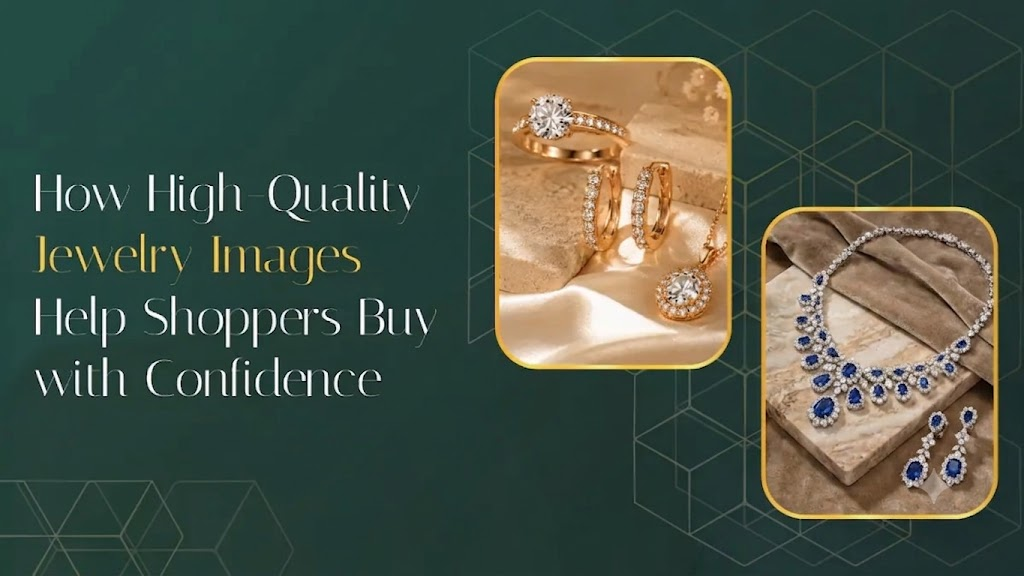
How High-Quality Jewelry Images Help Shoppers Buy with Confidence
Online jewelry shoppers don’t buy with their hands first; they buy with their eyes. In this market, customers can’t touch the metal, feel the craftsmanship, or see a gemstone sparkle in person.
Your product photos eventually become the entire shopping experience here. That’s why high-quality jewelry images are more than just visual assets; they’re the foundation of trust, perceived value, and conversion in jewelry ecommerce. cloudysocial, logicalshout, Immorpos35.3, feedworldtech, thestripesblog, mygreenbucks, designmode24, wtgtechgeek, uploadblog.
Crisp, detailed imagery that captures texture, brilliance, and true-to-life color helps shoppers feel confident about what they’re buying. It answers unspoken questions before they’re even asked:
Is this authentic?
Is it worth the price?
Will it look as elegant in real life as it does online?
In this article, we’ll explore how premium jewelry photos influence buying behavior, increase conversions, and help online stores turn admiration into revenue.
The Trust Problem: When Exactly Jewelry Buyers Hesitate Online
Buying jewelry is rarely just a transaction; it is almost always tied to an emotion. People buy jewelry to celebrate milestones, express love, or treat themselves to something that feels luxurious and permanent.
Because of this, buying a piece of jewelry online involves a massive leap of faith. Unlike a t-shirt or a book, a diamond ring or a gold necklace carries a high price tag and an even higher emotional weight.
When shoppers browse an online store, they cannot pick up the piece, feel its weight, or see how the metal catches the light when they move their hand. They are entirely dependent on what you show them.
What Happens When Jewelry Photos Are Low-Quality?
When a shopper encounters grainy, poorly lit, or amateurish photos, their brain instantly flags the store as untrustworthy. It triggers a cascade of skeptical questions:
- Is this real gold, or will it turn my skin green?
- Is that gemstone actually that color?
- Is the lighting hiding flaws?
- Is this business even legitimate?
Low-quality images signal a lack of professionalism. If a brand does not care enough to present its products beautifully, buyers assume the brand does not care about product quality or customer service either.
Instead of focusing on how stunning the jewelry would look on them, the customer is left guessing about the actual size, texture, and brilliance of the piece.
How Quality Jewelry Images Increase Conversion Rates
On the flip side, when you invest in pristine, high-end visuals, your conversion rates reflect that investment almost immediately.
| High-quality images act as a silent salesperson, answering questions about craftsmanship, quality, and scale before the customer even thinks to ask them. |
They bridge the gap between the digital screen and the physical product, giving buyers the reassurance they need to pull out their credit cards.
To achieve this level of perfection, many successful brands rely on professional jewelry photo editing services to clean up stray reflections, sharpen details, and ensure metals look appropriately lustrous.
5 Types of Jewelry Images That Shoppers Actually Want to See
To build absolute certainty, you cannot rely on just one or two photos. Buyers need a complete visual narrative. A well-rounded jewelry listing should include a mix of these five distinct image types.
1. Studio White-Background Shots
These are your foundational product images. Clean, crisp, and shot against a seamless pure white background, these photos keep the focus entirely on the jewelry. They are essential for marketplaces like Amazon and Google Shopping, offering a distraction-free view of the piece from the front, back, and sides.
2. On-Model Lifestyle Images
While white-background shots show the details, lifestyle images show the context. Seeing a necklace resting on a collarbone or a ring on a finger gives the shopper an immediate sense of scale, proportion, and styling possibilities. It transforms the piece from an isolated object into a wearable accessory.
3. Close-Up Macro Details
Jewelry is all about fine craftsmanship. Macro shots zoom in closely to showcase the intricate prongs, the clarity of the gemstones, the quality of the engraving, and the security of the clasps. This level of transparency proves to the buyer that you have nothing to hide.
4. 360° and 3D Views
Static images can only do so much. A 360-degree or interactive 3D view allows shoppers to virtually rotate the piece, watching how the metal reflects light from every conceivable angle. This interactive element mimics the physical experience of holding the jewelry in a brick-and-mortar store.
5. AI-Generated Lifestyle Shots
A massive breakthrough for brands looking to scale, AI-generated lifestyle shots place your product onto hyper-realistic virtual models or into beautiful lifestyle settings without the massive expense of traditional photoshoots. This allows brands to showcase a wider variety of skin tones and fashion styles effortlessly.
Why On-Model Jewelry Photos Are the Secret to Closing Sales
If you had to pick just one type of image to upgrade your store, it should be the on-model shot. There is a profound psychological shift that happens when a customer sees jewelry worn by a real person.
How Seeing Jewelry “In Real Life” Builds Visual Confidence
It is incredibly difficult to judge the size of a pair of earrings or the thickness of a chain simply by reading dimensions like “4mm” or “18 inches” in a text description.
When those earrings are shown on a model, the buyer instantly understands exactly where they will sit against the jawline. It removes the mental math and replaces it with instant clarity, making the buying decision much easier.
The Return Reduction Benefit
When customers know exactly what to expect in terms of size and scale, your return rates plummet. A large percentage of jewelry returns happen simply because the item was smaller or larger than the buyer imagined.
On-model photography aligns customer expectations with reality, saving your business thousands of dollars in reverse logistics and restocking fees.
How AI and 3D Technology Are Reshaping Jewelry Photography
The jewelry industry is undergoing a massive digital evolution, making high-end imagery more accessible to brands of all sizes while creating a more immersive experience for the shopper.
AI Jewelry Photography: Instant Lifestyle Shots
Traditionally, hiring models, photographers, stylists, and renting a studio cost thousands of dollars per shoot. AI technology has completely disrupted this model.
Today, jewelry brands can take a standard studio shot and use advanced AI tools to generate beautiful, contextual lifestyle images instantly. This drastically reduces time-to-market for new collections while giving customers the rich visual variety they crave.
3D/AR Try-On: Impact of Virtual Testing
Augmented Reality (AR) has turned smartphone cameras into virtual dressing rooms. Shoppers can now use their cameras to see how a ring looks on their own hand or how a watch fits their wrist in real time.
This interactive “try-on” technology builds immense visual confidence, driving up conversions while driving down return rates to historic lows.
7 Common Jewelry Photography Mistakes That Kill Confidence (And How to Fix Them)
Even the most beautiful piece of jewelry can look cheap if the photography is poorly executed. Avoid these common missteps to keep your brand looking premium.
Mistake 1: Sloppy Preparation and Dust on Pieces
- The Problem: High-resolution cameras catch everything. A single fingerprint, speck of dust, or microscopic scratch can look glaringly obvious on a screen.
- The Fix: Always wear cotton gloves when handling jewelry for a shoot, and use a microfiber cloth and compressed air to clean every piece right before snapping the photo.
Mistake 2: Busy Backgrounds That Distract from the Product
- The Problem: Distracting patterns, textures, or cluttered props pull the viewer’s eye away from the jewelry, making the listing look messy.
- The Fix: Stick to clean, neutral backdrops, like pure white, soft grey, or subtle slate, that allow the jewelry to be the undisputed star of the show.
Mistake 3: Poor White Balance and Inaccurate Colors
- The Problem: If your camera’s white balance is off, yellow gold can look like cheap brass, and white gold can look like dull steel.
- The Fix: Use a grey card to calibrate your camera’s white balance before shooting, ensuring colors are completely true to life.
Mistake 4: Uncontrolled Reflections on Metal/Gems
- The Problem: Highly polished metals act like mirrors, reflecting the camera lens, the photographer, or weird overhead room lights.
- The Fix: Use a diffusion tent or light boxes to soften the light source, creating smooth, clean gradients across metallic surfaces.
Mistake 5: Soft Focus Instead of Sharp Macro Detail
- The Problem: If only a small part of the ring is sharp while the rest blurs away aggressively, the customer can’t judge the overall quality.
- The Fix: Shoot with a narrower aperture (higher f-stop number) or use focus-stacking software to ensure the entire piece remains crisply in focus from front to back.
Mistake 6: Inconsistent Image Style Across Listings
- The Problem: If one listing has warm, dark lighting and the next has bright, cool lighting, your storefront looks chaotic and untrustworthy.
- The Fix: Create a standardized photography guide detailing your lighting setup, angles, and editing style so every product feels like it belongs to the same family.
Mistake 7: No On-Model or Lifestyle Context
- The Problem: Showing jewelry only on a white background leaves the customer guessing about how it actually looks in the real world.
- The Fix: Ensure every product listing includes at least one lifestyle or on-model photo to provide vital context and scale.
Frequently Asked Questions
1. Do product images really affect online jewelry sales?
Absolutely. Because jewelry is a high-touch, sensory item, online buyers rely entirely on visuals to evaluate quality. Exceptional images build trust, answer questions about craftsmanship, and are the single biggest factor in converting a casual browser into a paying customer.
2. How many images should I have per jewelry listing?
Aim for a minimum of 5 to 7 images per piece. This should include a hero shot on a white background, a few macro close-ups of the details, an on-model photo for scale, and an interactive 360-degree view if possible.
3. What’s the best background for jewelry photography?
For standard e-commerce listings, a pure, seamless white background is the industry standard. For social media and branding, soft neutrals like cream, marble, slate, or natural wood work beautifully without distracting from the piece.
4. Are on-model photos necessary for jewelry e-commerce?
While you can launch without them, they are highly recommended if you want to scale. On-model photos remove all ambiguity regarding size and scale, which dramatically improves conversion rates and reduces returns.
5. How do I edit jewelry photos for Amazon and Shopify?
Start by cropping tightly and centering the product. Clean up any dust, blemishes, or unwanted reflections, and adjust the brightness and contrast to make the metals pop. Finally, ensure the background is pure white for Amazon compliance, and export high-resolution, web-optimized files so your pages load quickly.
Start Using Confidence-Building Jewelry Images Today
Upgrading your visual strategy isn’t just about making your website look prettier; it’s about fundamentally changing how secure a customer feels doing business with you. When you replace doubt with visual clarity, sales naturally follow.
Here are your next three steps to take your high-quality jewelry images to higher conversions:
- Audit Your Current Listings: Go through your top-selling items and check if they include macro details and on-model context.
- Clean Up Your Edits: Ensure your metal tones are accurate and free of distracting reflections, utilizing professional polishing and editing help where needed.
- Incorporate Context: Begin experimenting with AI lifestyle tools or simple on-model shots to give your jewelry the real-world scale your buyers are looking for.